
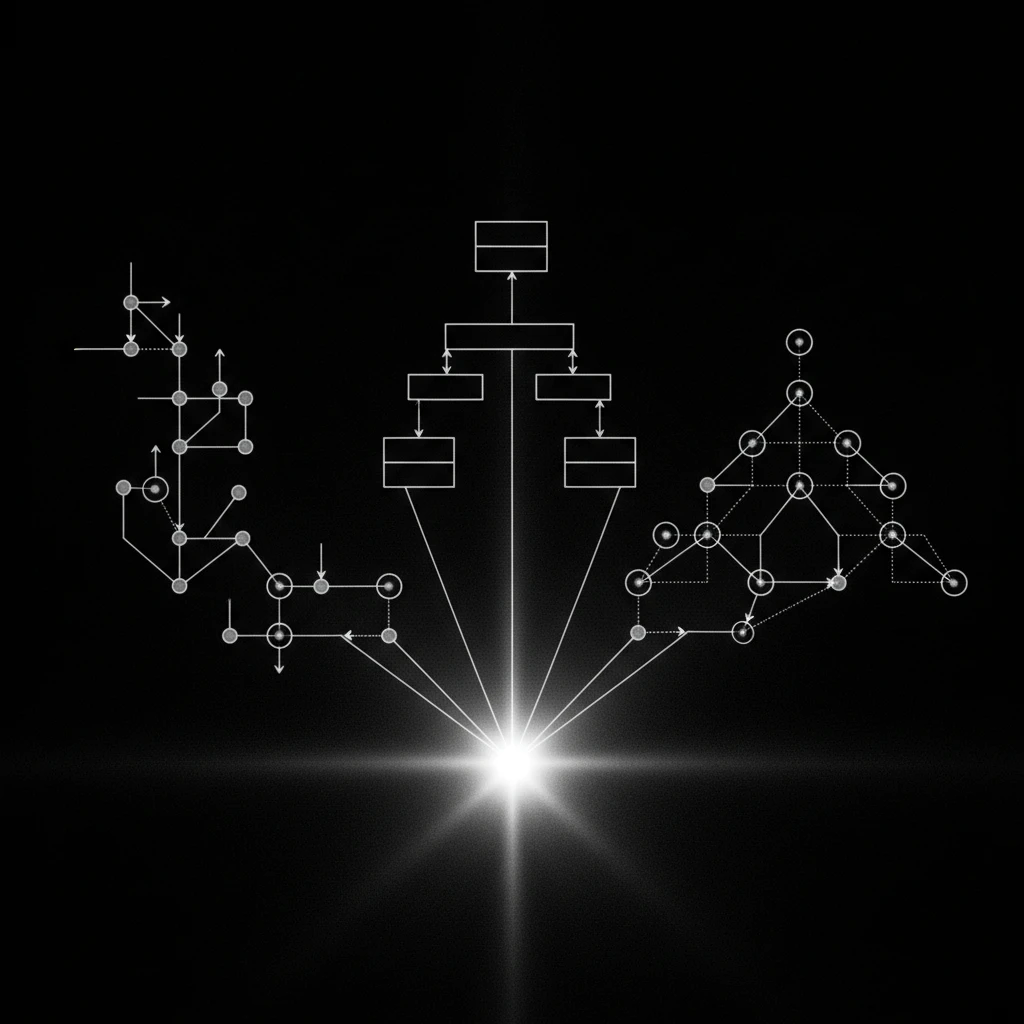
The Paradigm Shift in Multi-Agent Orchestration
As enterprise generative AI deployments transition from single-prompt copilots to fully autonomous, multi-step execution workflows, selecting the right multi-agent orchestration framework has become a core infrastructure decision. Engineering teams across global enterprises are discovering that raw model intelligence is insufficient without structured state management, deterministic control flow, and robust tool execution protocols.
Recent technical surveys published in research preprints like The Orchestration of Multi-Agent Systems (arXiv:2601.13671) emphasize that modern orchestration layers must formalize state management, policy enforcement, and inter-agent communication protocols to survive enterprise scale and compliance scrutiny. For a foundation in core concepts, explore our Essential Guide to Understanding Agentic Frameworks.
Architectural Overview: LangGraph, CrewAI, and AutoGen
The open-source multi-agent ecosystem has consolidated around three primary design patterns, each optimized for different developer priorities and execution profiles:
- LangGraph (LangChain Ecosystem): Uses a directed acyclic graph (DAG) or cyclic state machine model where agents operate as stateful functions. It offers granular control over state persistence, node-level retries, and checkpointing.
- CrewAI: Employs role-based agent delegation where autonomous sub-agents function as specialized team members assigned to explicit tasks and tools. Highly intuitive for rapid prototyping and linear workflows.
- AutoGen / Microsoft Agent Framework: Focuses on conversational multi-agent patterns and emergent reasoning where agent interactions are modeled as structured peer-to-peer dialogues or hierarchical chats.
Comparing State Management and Control Flow Protocols
When selecting a framework for enterprise-scale workloads, architectural trade-offs determine whether a system remains maintainable under heavy transaction loads. The table below highlights key parameters across the three primary frameworks:
| Metric / Feature | LangGraph | CrewAI | AutoGen / Microsoft Agent |
|---|---|---|---|
| Core Architecture | Graph-based State Machine | Role & Task Delegation | Conversational Dialogue |
| Execution Control | High (Deterministic Graph Edges) | Medium (Task Sequence & Delegation) | Dynamic / Emergent Dialogue |
| State Checkpointing | Native Durable Memory & Rollbacks | In-memory Scratchpad & Replay | Conversation History Logs |
| Enterprise Fit | Strictly Governed & Auditable Pipelines | Rapid Prototyping & Modular Teams | Research & Unstructured Reasoning |
To see how autonomous systems are actively transforming day-to-day operations across industries, read our deep dive on How Agentic Systems Are Reshaping Productivity Daily.
Real-World Enterprise Architectures: SLMs and Agent Meshes
Enterprise case studies reveal a shift away from single massive reasoning models toward multi-tier orchestrations combining orchestrator agents with small language models (SLMs). A notable example is AT&T, which restructured its AI stack around a multi-agent orchestration approach where a master super-agent routes specialized tasks to lightweight SLM worker agents. As documented by VentureBeat’s coverage of AT&T’s multi-agent stack, this architecture achieved up to a 90% reduction in token costs while processing over 27 billion daily tokens.
Similarly, financial platforms like Brex are implementing an “Agent Mesh” architecture that favors decentralized, role-specific agents communicating in plain language over central monolithic controllers (VentureBeat: Brex Agent Mesh). In financial reconciliation, institutions like Moody’s have leveraged modular agentic tools to reduce credit memo processing time from 40 hours to under 2 minutes (VentureBeat: Moody’s Modular AI Case Study).
For further perspectives on autonomous agent evolution, check out The Rise of Truly Autonomous Digital Agents.
Selecting the Right Multi-Agent Orchestration Framework
To choose the optimal framework for your engineering team, evaluate your workflow requirements against these key decisions:
- Choose LangGraph if: Your system requires deterministic state routing, human-in-the-loop validation, step-level rollbacks, and strict auditing for regulatory compliance.
- Choose CrewAI if: You need to quickly deploy role-driven workflows (e.g., content creation pipelines, simple document analysis crews) with minimal boilerplate code.
- Choose AutoGen / Microsoft Agent Framework if: Your problem domain requires dynamic multi-agent negotiation, open-ended problem exploration, or multi-agent debate prior to output synthesis.
- Choose a Custom Mesh / Control Plane if: You manage thousands of heterogeneous models and require vendor-agnostic resilience across cloud infrastructure.
Frequently Asked Questions
Which multi-agent framework provides the highest execution control for complex enterprise workflows?
LangGraph provides graph-based state machines with fine-grained node/edge control, durable state checkpoints, and human-in-the-loop interjections, making it ideal for highly structured deterministic pipelines.
How does CrewAI differ from LangGraph and AutoGen in system design?
CrewAI relies on role-based crew delegation where agents act like specialized employees assigned to explicit tasks, enabling rapid prototyping and fast time-to-market.
Why are enterprises adopting Small Language Model (SLM) agent architectures?
Using SLM worker agents directed by a master orchestrator dramatically reduces token cost (up to 90%) and improves execution speed while maintaining domain-specific accuracy.
For more research articles and technical guides, visit our AI Resources Center and browse our latest analysis on the Agentic AI Blog.
Leave a Reply